
 Dispatches from the valley where you pay in bitcoin.
The unbearable immutability of tulips
This story appeared on 28 January 2019 on the inbitcoin website, in a column of which only this issue survives in the archive. The market had crashed a year earlier and the tulips were back in the papers: this is the reply, with a smile. Rewritten in 2026 to read more smoothly: the story is the same. The translation is ours.
This is the greatest bubble story of all time. Back in the 1600s, the Dutch, they get speculation fever to the point that you could buy a beautiful house on a canal in Amsterdam, for the price of one bulb. They called it "Tulip Mania." Then it collapsed. You could buy 10 bulbs for $2. People got wiped out, but, you know, who remembers?
“Who remembers?” It's a line from a film, and anyone who remembers it remembers it wrong: things didn't go quite like that.
Is Bitcoin like the tulip bubble? What if, instead, it were the tulips that were like Bitcoin?
Let us imagine a world identical to ours, except that tulips are money.
Tulips, as everyone knows, are a special flower: since time immemorial they have been traded all over the world for goods and services.
Limited in number
In 2019 there are exactly 17,485,425 tulips in circulation. They will grow a little at a time, through careful selection, up to the maximum ceiling of 21 million, in 2140.
Unfortunately nature doesn't go along 100% with the rules laid down by man. Every so often it also brings forth wild tulips, uncensused and completely illegal.
And so men, to stay faithful to their tulip-based economic system, set up a higher supervisory body: the Tulip Police. Its task was to keep in check every budding tulip that tried to destabilise the world number of tulips. An arduous and ferocious undertaking!!
The Tulip Police (TP) employed an incredible number of officers. Just consider that guarding the 12 tulip gardens of one Eastern ruler took a staff of 1,000 Tulip Officers. For every new tulip in the world, a TP agent had to seek it, find it and uproot it. Work that left these special men neither sleep nor peace!!
Immutable
The reader will wonder: and how was the tulip's immutability maintained?
Ah, another laborious matter!
It wasn't only the global number of tulips that was checked: the properties of each one were recorded over time as well. A tulip is perishable, subject to the years and to the weather. So it was monitored every minute, one by one, so that its “immutability” might be preserved!
Every tulip had a personal file, updated continuously by notaries the world over, with all, and I mean “all!”, its characteristics. When a tulip began to decline, an almost identical one was tracked down (often a clone) to take its place at the moment of death.
Any attempt at fraud was a crime. Few people ended up in prison, though: almost the entire population was employed as notaries or as TP agents.
Transmissible at a distance
Bitcoin can be sent at a distance. And tulips? How did global trade work?
Well: if keeping the number of tulips and their characteristics in check was already an undertaking, exchanging them was harder still! For every tulip traded one had to follow a long, cumbersome and costly procedure, together with a notary and a TP agent.
Suppose that Linda, in Rome, wants to send 1.42 tulips to Giacomo, in Milan. A wearying bureaucratic procedure awaits her: she must find a notary and a TP agent free that day, and she must have set aside a substantial commission to pay for the service.
Here we are, then. Linda calls the notary and the agent to her home and explains what she wants to do. The notary prepares to handle a commodity tulips future contract:
“Now then: today, with us, you undertake to send 1 physical tulip. The remaining 0.42 we ‘carry on paper’. Let me explain. You would like to divide the second tulip into two parts, 0.42 + 0.58. The 0.42 passes into Giacomo's ownership by means of the contract we ask you to sign, in the presence of at least 2 witnesses: in this case the agent and myself.
The original of the contract we will register and keep in our archives, in a perennial, crystallised case, open to public view by the community. One copy stays with you and one goes to Giacomo.
The second tulip remains physically in its pot. The 0.42, however, will no longer be yours to dispose of: it is notarised that this specific portion belongs to Giacomo.”
And so the notary and the agent begin to certify the properties of the tulips: the shade of the petals, the age, the length, the count of petals and parasites, any lesions, and so on.
With every detail recorded, the notary confers with the TP agent and the two start telephoning Milan. There must be 1 tulip available there, as nearly identical as possible to the one to be moved. It is usually found in the secret tulip reserves, guarded by the military and kept off the free market.
At that point Linda's tulip is uprooted from its pot and destroyed. In its place there is now a tulip in Milan, “shipped” to Giacomo together with the signed contract, worth 0.42 tulips plus VAT. What a slog!
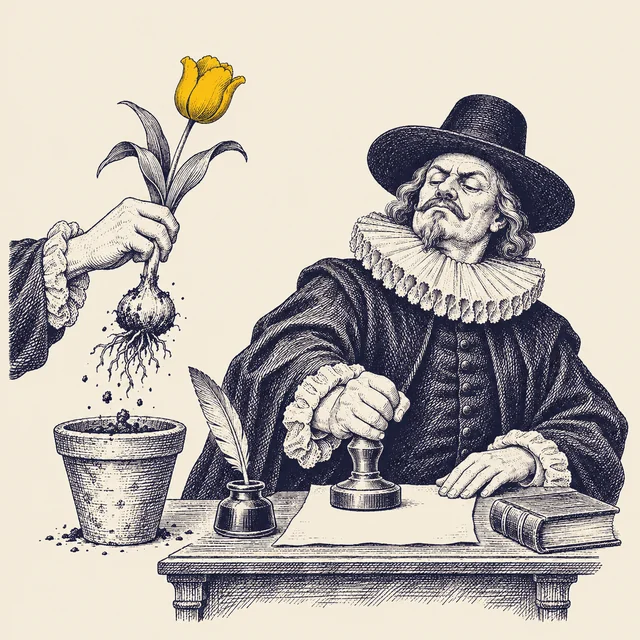
Sending 1.42 tulips, in five steps
| Step | With tulips | With Bitcoin |
|---|---|---|
| 1 | A notary and a Tulip Police agent free that day | Your phone |
| 2 | A commodity tulips future contract: 0.42 “on paper” | A 0.42 output |
| 3 | Phone calls to Milan to find an identical tulip | The network tells everyone within seconds |
| 4 | Linda's tulip is uprooted and destroyed | Nothing is destroyed |
| 5 | 0.42 tulips plus VAT, when the paperwork is done | 0.42 bitcoin, plus the network fee |
In this short text we have imagined carrying some of Bitcoin's properties over to tulips. For others, such as programmability or notarisation, the effort of imagination would be almost prohibitive: we invite our bolder readers to try their hand and send us their stories.
Our cue, this time, was some well-known and mistaken comparisons we have been reading in the papers for years. Other tales, more or less fantastical, will appear in this new column, which we inaugurate here: Tales of Orgonic Cryptology. Until next time!
The ending, written in 2026
The true story of the tulips is smaller than the legend. The Dutch fever lasted one winter, from 1636 to 1637, and died out at the beginning of February, when the buyers disappeared. The canal houses swapped for a bulb, the chain of bankruptcies and the ruined country come mostly from the moralising pamphlets of the time and from Charles Mackay, who took them up in 1841. In the Dutch archives Anne Goldgar did not find a single bankruptcy caused by tulips.1
Bitcoin is something else: a digital ledger that nobody controls on their own, running for seventeen years. The price goes up and down, sometimes a lot. But its average price over the last five years, which smooths out the highs and lows, has practically never fallen since it could first be calculated: in August 2015 it was about 200 dollars, today it is about 59,000.2
A bubble lasts one season. Bitcoin is a path that keeps climbing.
From the story to the till: where to pay in bitcoin All the lessons
-
Anne Goldgar, Tulipmania: Money, Honor, and Knowledge in the Dutch Golden Age, University of Chicago Press, 2007; the review in Reviews in History and the summary from History.com. ↩
-
Our calculation of 11 November 2026 from the average daily price in dollars published by blockchain.com, which starts on 18 August 2010: for each day, the average of the previous five years. The first value is from 17 August 2015, and since then the average has practically never fallen. ↩