
 Dispatches from the valley where you pay in bitcoin.
Why anyone cares
Knowing what it is doesn't answer the next question: what it's for, and for whom.
Three eggs instead of four
Great-grandma saved by buying three eggs instead of four. For Grandma that was no longer enough: she had to buy Italian treasury bills. Dad had to study the markets. Today a brilliant surgeon has to double as an investor who's always up to date just to hold on to what they earn, and that time is a cost to all of us.1 “Saving is not investing,” said one of our slides in 2022.2
It's called inflation: prices go up, and with the same euros you buy less. The European Central Bank wants it at 2% a year: that is its target.3 A hundred euros left sitting for twenty years buy what you can buy today with 67.
There's an experiment here: how many eggs the money for a hundred eggs buys over the years if you leave it sitting there. At 2% a year, after twenty years, about 67. It needs JavaScript; the lesson works fine without it.
A thousand lire a month
In 1939 a song dreamed of a salary of a thousand lire a month. Today a thousand lire is 52 euro cents.4 We bring it up because we Italians ought to know better than most what can become of a currency.
In Trentino, Austrian until the First World War, it happened without any songs. In the spring of 1919 the Austrian crown was converted into lire, and the money in circulation lost forty per cent against the pre-war exchange rate, much to the resentment of people who had only just come through a war.5
What money is
A rice grower has a hard time trading with another rice grower: they both have the same thing and both want something else. Money started out as a technology for trading, and in our courses we told its story in five eras.
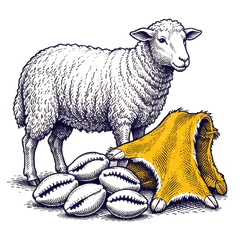 A useful goodsheep, hides, shells. From pecus, sheep, comes pecunia, money
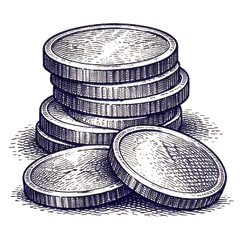 Metalgold and silver
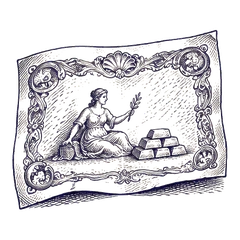 The promisethe banknote that said “one pound of sterling silver”
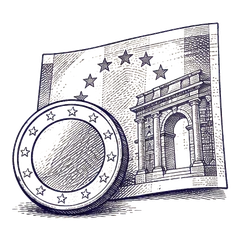 Legal tendereuro, dollar: no metal behind it
 Mathematical moneyBitcoin
| Era | What it rests on | Whom you trust |
|---|---|---|
| A useful good | It's worth something in itself: a sheep is a sheep | No one |
| Metal | Gold and silver | No one |
| The promise | The banknote that said “one pound of sterling silver” | The bank |
| Legal tender | The laws and the taxes paid in euros | The central bank and the State |
| Mathematical money | Bitcoin's accounts, which you check yourself | No one |
In the first, the second and the last, you don't have to trust anyone: a sheep is a sheep and gold is gold, provided you can tell a healthy sheep and a real gold bar. Bitcoin's books are checked by your own software, even if you're no expert. The third and the fourth are promises, and they're only worth something as long as someone keeps them.
A good currency lasts, fits in your pocket, divides and can't be made at will. And it does three jobs: it holds value over time, it passes from hand to hand, it gives things their prices. Gold holds value, but breaking it up and shipping it is hard work; a bitcoin divides into a hundred million satoshis and goes to the other side of the world like a message.6
Since 15 August 1971 there has been no gold behind the dollar: that day the United States stopped exchanging other states' dollars for gold, and since then legal currencies are worth what the trust in whoever issues them is worth.7
Caesar's voice
Central banks see it the other way round. In November 2022 two officials of the European Central Bank, Ulrich Bindseil and Jürgen Schaaf, wrote that Bitcoin is suitable neither as a means of payment nor as an investment, and that it was on the road to irrelevance.8 Fair enough: the money we're talking about here gets by without Caesar.
Money with no Caesar
People had long imagined putting money on the internet. What was missing was a way to do it “without the central authority and without a hierarchy” (our translation).9 Where power is greatest, so is the incentive to corrupt, so the hierarchy was taken out. Bitcoin doesn't ask anyone to be good: everyone pursues their own interests, and the mechanism adds those interests up into a ledger anyone can check.
The telegraphists
We call it crypto-anarchy, a word that comes from the cypherpunks, and we explain it with telegraphy courses: nobody went from house to house killing telegraphy teachers; they simply stopped being needed. Some functions of the state can go the same way, without anyone tearing them down by force.10
Machines too
An AI agent is a program that works on its own on someone's behalf: it searches, compares, buys a piece of data or an hour of computing time. It can't open a bank account, sign a contract or show an ID. Bitcoin doesn't ask it to: all it takes to pay is a key, and with Lightning a few sats at a time will do, even for a single answer.
That's why agents, and the people who build them, like Bitcoin. In February 2026 Lightning Labs released open-source tools that let an agent pay and get paid over Lightning, with no accounts, sign-ups or API keys.11 Money with no Caesar also suits someone who wouldn't even know where to look for Caesar.
If the system worked
On a flyer we put it like this: maybe we wouldn't need Bitcoin if inflation didn't eat into families' savings, pushing them to invest and to hand their money to others. If governments and central banks always acted in the citizens' interest. If everyone in the world had access to an account, and money never became a tool of political pressure: until the 2019 reform, the central bank of eight West African countries, those of the CFA franc, had to keep half its reserves in an account at the French Treasury.12 If sending money home didn't cost, on average worldwide, 6.5% of every 200 dollars.13 If power grids didn't need someone to buy the energy left over.14
Bitcoin exists because that's not how it is.
It's not the same for everyone
If you struggle to make ends meet, digital gold means nothing to you. The owner of a bar in Rovereto wouldn't hear a word about money, and was won over by listening to a discussion about crypto-anarchy.15 Our advice is not to sell everyone the same Bitcoin:16 everyone comes in through a door of their own.
Three questions
You'll hear them in the shop. Have a go at answering, then open them.
“What's great-grandma got to do with it?”
She saved by buying three eggs instead of four. Today, to hold on to what you earn, you have to be a trader as well. We think Bitcoin can make saving simple again.
“What does money with no Caesar mean?”
That there's no authority that can print more of it or block a payment. The rules live in the software, anyone can read them, and to change them the network has to adopt the change.
“So it's good for everyone?”
Not in the same way. If you struggle to make ends meet, digital gold means nothing to you, and everyone comes in through a door of their own, in their own time.
Lesson 3: the first wallet and the first satoshis All the lessons
-
Amadori on luogocomune2, 2022, min. 7. ↩
-
Slide from the TEDx talk in Belluno, June 2022, no. 19. ↩
-
European Central Bank, the monetary policy strategy: an inflation target of 2% over the medium term, set at the conclusion of the strategy review in July 2021. ↩
-
Amadori on Media Pluralisti, 2025, min. 7, where he rounds to 50 cents. The calculation at the rate of 1,936.27 lire to the euro is ours. ↩
-
Il 3 novembre 1918 l'esercito italiano entrava a Trento, L'Adige, 3 November 2014. ↩
-
Slides of the Basics course, March 2025, nos. 27-28; the three functions (medium of exchange, unit of account, store of value) are also in the microbook Bitcoin Money, section “What money is”. ↩
-
Federal Reserve History, “Nixon Ends Convertibility of U.S. Dollars to Gold and Announces Wage/Price Controls”: on the evening of 15 August 1971 Nixon announces the closing of the “gold window”, and foreign governments can no longer exchange their dollars for gold. ↩
-
The ECB blog of 30 November 2022, “Bitcoin's last stand”, as reported by CNBC. ↩
-
Marco Amadori at ImpAct, 2025: see The Padua speech. ↩
-
Amadori on Sicurezza Bitcoin, 2025, min. 26. ↩
-
The Agents Are Here and They Want to Transact, Lightning Labs, 11 February 2026. ↩
-
French Treasury, “Réforme des relations de coopération monétaire entre l'UEMOA et la France”, 23 December 2019: the reform announced in Abidjan on 21 December ends the obligation to centralise the BCEAO's reserves at the Treasury. ↩
-
World Bank, Remittance Prices Worldwide, issue 53, first quarter of 2025: global average cost of sending 200 dollars, 6.49%. ↩
-
Flyer from the Via Rialto shop, “Perché bitcoin?” (“Why bitcoin?”), 2025, in the shop's archive. ↩
-
Amadori on Final Step Bitcoin, 2026, min. 50. ↩
-
Amadori on Villaggio Bitcoin, 2025, min. 6. ↩